EXPLAINERS · AUG 15
Morning Frost: Ice That Was Never Dew
Frost explained: how ice grows straight from vapor on clear calm nights, and why the grass can freeze while the thermometer reads above 32.

Grounded in National Weather Service definitions; suitable for classrooms and other curious humans.
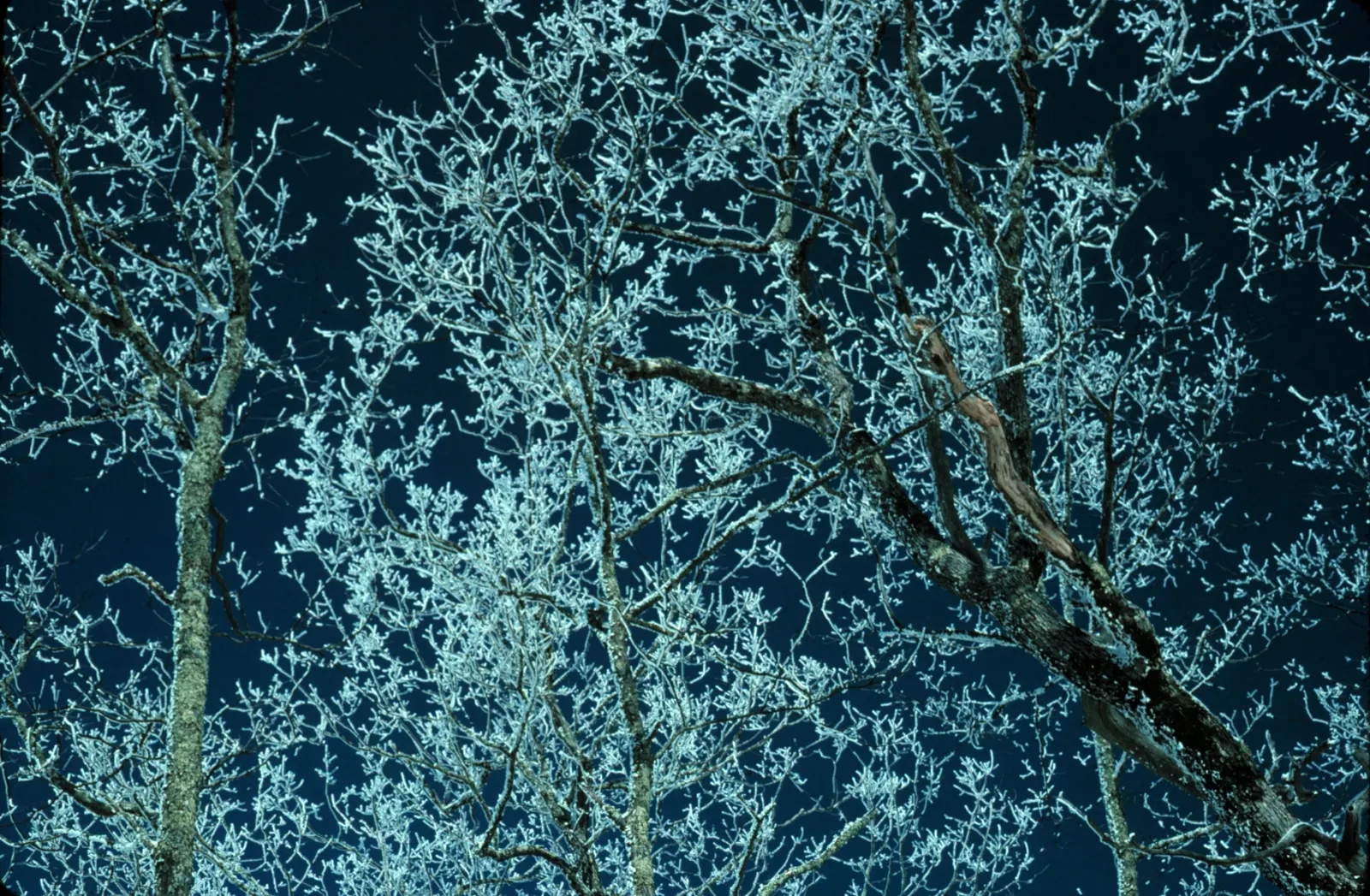
Frost forms when a surface cools to freezing and below, and water vapor in the air turns directly into ice crystals on it, skipping the liquid stage. That direct jump is called deposition, and it is why frost grows as feathery crystals instead of frozen droplets. The recipe needs a clear sky and calm air, so the ground can radiate its heat away all night undisturbed. And because official temperature is measured several feet up while the ground runs colder, frost can whiten your lawn on a night the thermometer never admits reached freezing.
Not frozen dew
The natural assumption is that is dew that froze after the fact: water beads up on the grass, the temperature slides below 32, the beads harden. That does happen, and it produces little frozen droplets with a glassy look. But it is not frost, and the difference is worth having.
True frost never spends a moment as liquid. When a surface is at or below freezing, water vapor touching it turns directly into ice, molecule by molecule, building crystals on the cold surface the way sugar crystals build on a string. The direct jump from vapor to ice is called of cloud. Full sun.">clear night, and it is why frost is not frozen dew.">deposition. It is the reverse of the trick a snowbank pulls in spring when it shrinks for days without ever making a puddle.
Crystals built molecule by molecule come out as structure: ferns, feathers, spikes, the white fur on the car roof. That architecture is why frost sparkles and frozen dew merely glistens. The sparkle is the tell that the liquid step was skipped.
The recipe: clear, calm, and long
All day the ground soaks up sunshine. All night it radiates that heat away at the sky. Whether frost forms is mostly a question of whether anything interferes with the radiating, which gives the recipe three ingredients:
- A clear sky. Clouds catch outgoing heat and send some back down, working exactly like a blanket. Under an open sky the ground's heat leaves for space with nothing in the way, and surfaces cool hard. This is , and a long autumn night gives it hours to work.
- Calm air. Wind stirs the coldest air at the surface back in with milder air a little higher up, and the mixing keeps the ground from bottoming out. Still air lets a thin, deeply cold layer settle right where the grass lives.
- Moisture, but not too much. There has to be vapor in the air to build crystals from. Bone dry air can drop below freezing and leave nothing but a brown, disappointed lawn, which forecasters distinguish as a without frost.
Frost at 37 degrees
Here is the part that gets forecasters accused of lying. Official temperature is measured by instruments standing several feet above the ground. On a clear calm night, the coldest air is not up there; it is in the bottom few inches, pooled on the grass, and it can run well colder than the instrument height. So the morning news can honestly report a low of 36 or 37 while your windshield honestly reports winter. Both are right. They were measuring different altitudes, a few feet apart.
Cold air also behaves like water: it is denser than warm air, and on calm nights it drains downhill and pools in hollows and valley floors. Gardeners on a hilltop and gardeners in the dip below it live in different climates every clear October night, and the dip pays for the view it does not have.
The frosts that matter
Frost earns its forecasts because of what it does to growing things. Ice crystals forming inside plant tissue shred cell walls, which is why frostbitten leaves come up limp and blackened. The stretch between the last frost of spring and the first frost of fall is the growing season, and the Weather Service issues frost advisories and freeze warnings in those shoulder weeks precisely because one calm clear night can end a garden that took a whole summer to build.
The defense is the same physics run in reverse. Covering plants at dusk traps the ground's outgoing heat under the cover, a private cloud for one tomato bed. The rock, which does not grow anything and has never once been harmed by frost, still admires the trick: it is the only weather problem a bedsheet reliably solves.
Reading the morning
Frost is also a report, if you read it. It writes down where the cold pooled: the frosted stripe at the bottom of the yard, the clear patch under the tree that acted as a blanket, the white car roof facing open sky while the one under the carport stayed grey. One lawn, one night, and a complete map of how heat moved while you slept. The rock reads it every cold morning and has yet to find a typo. If the night's cooling only got as far as liquid drops, you get dew instead, and that story is told in the dew point lesson.
Words in this lesson
Every marked word above is here in full, because a definition that only appears on hover is no use to somebody reading on a phone, printing the page, or listening to it.
- Clear
- Zero to one okta of cloud. Full sun.
- Deposition
- Water vapour turning straight into ice without ever being liquid in between. It is how frost builds its crystals on a cold clear night, and it is why frost is not frozen dew.
- Freeze
- Air at or below 32 F.
- Frost
- Surface ice crystals near 32 F. Kills tender plants.
- Okta
- One eighth of the sky. Sky cover is counted in oktas, from zero for clear to eight for overcast, which is why the familiar sky words are really just bands of a number.
- Radiational cooling
- The ground losing its heat to the night sky. On a clear, calm night nothing blankets the loss or stirs warmer air back down, so surfaces cool hard; clouds or wind slow the drain.
This is a Foundation lesson
It belongs to the Weather School, which is free and always will be: twenty lessons from toddler to adult, every one with a printable worksheet and answer key that any classroom may copy. No account, no cost, no catch.
Another one at this level: chance of rain.
For teachers and every lesson.
Definitions in this explainer follow the National Weather Service. The rock checked twice. The rock always checks twice.