EXPLAINERS · AUG 8
The Layers of the Atmosphere
The five layers of the atmosphere with the National Weather Service's own numbers: how high each one reaches, why the temperature reverses direction four times on the way up, and why every bit of weather happens in the bottom one.

Grounded in National Weather Service definitions; suitable for classrooms and other curious humans.
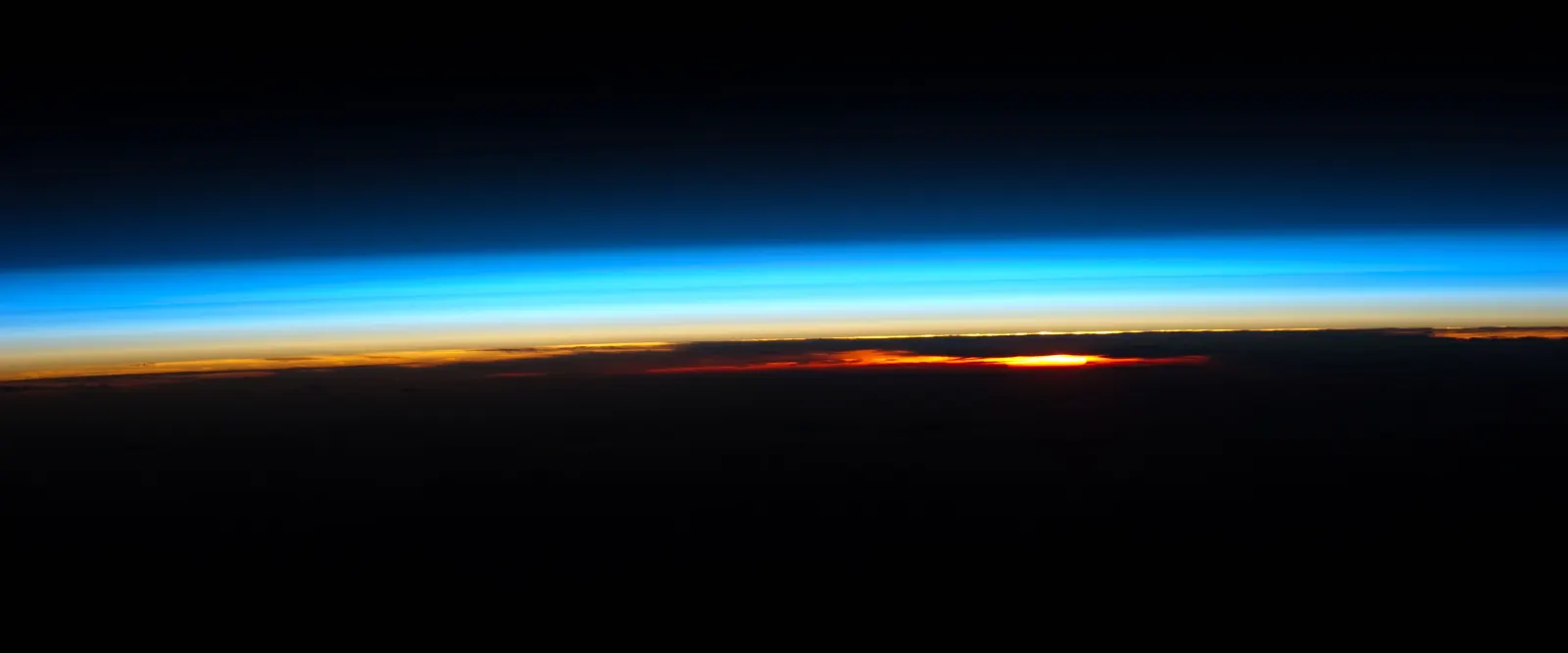
The atmosphere is sorted into five layers by what the temperature does as you climb: troposphere, stratosphere, mesosphere, thermosphere, exosphere. Temperature falls, then rises, then falls, then rises again, and each reversal marks a boundary called a pause. Almost all weather happens in the troposphere, the thin bottom layer whose ceiling sits anywhere from just under four miles up at the poles to twelve miles up at the equator.
Five layers, sorted by temperature
The layers are not stacked by height so much as by behavior. NOAA identifies five distinct layers using thermal characteristics, chemical composition, movement, and density, and separates them with boundaries called pauses, where those characteristics change fastest. The shorthand that actually helps: every time the temperature stops doing one thing and starts doing the opposite, you have crossed into a new layer.
The troposphere: the only layer that rains
Almost all weather occurs here. It starts at your feet, and its ceiling depends on where you are standing. NOAA gives three anchors: the troposphere is 11 to 12 miles (18 to 20 km) high at the equator, 5 and a half miles (9 km) at 50 degrees north and south, and just under four miles (6 km) high at the poles.
Temperature falls with height the whole way, from an average of about 62 F (17 C) near the surface to -60 F (-51 C) at the top. That falling temperature is what permits cloud, every shower and every thunderstorm.">convection. Air warmed near the ground is less dense than the colder air sitting above it, so it can rise, and rising air is the engine behind every cloud, every shower, and every the rock has ever sat through.
The tropopause: the lid
At the top of the troposphere the cooling stops. Above that boundary the temperature starts increasing with height, which puts warmer air on top of cooler air, and that arrangement shuts vertical motion down. There is no upward push left to give.
You can see the lid with your own eyes. When a thunderstorm's runs out of buoyancy near the tropopause, it spreads sideways instead of upward, and that spreading is the flat anvil top on a big storm. The sky is showing you exactly where one layer ends.
The stratosphere: warm on top, and 19 percent of the air
The stratosphere runs from the tropopause, somewhere between 4 and 12 miles (6 to 20 km) up depending on latitude, to around 31 miles (50 km). It holds 19 percent of the atmosphere's gases and very little water vapor. Its temperature climbs from that -60 F (-51 C) at the tropopause to a maximum of about 5 F (-15 C) at the top. The warming comes from the making of ozone: heat is produced in the process of ozone formation, and that heat is what raises the temperature with height. The boundary at the top is the stratopause.
The mesosphere: where meteors end
From around 31 miles (50 km) to 53 miles (85 km). Temperature falls again with height, or said the other way, it rises as you descend, reaching about 5 F (-15 C) near the bottom. The gases here are thin, but by now they are thick enough to slow a meteor until it burns, which is the fiery trail you see at night. The stratosphere and the mesosphere together are called the middle atmosphere, and the top of the mesosphere is the mesopause.
The thermosphere: hot without being warm
From about 53 miles (85 km) to 375 miles (600 km). Incoming high energy ultraviolet and X-ray radiation from the sun gets absorbed by molecules here, and the temperature climbs hard: from as low as -184 F (-120 C) at the bottom to as high as 3,600 F (2,000 C) near the top.
Which sounds lethal, and is not, at least not for that reason. Temperature describes how much energy the individual molecules are carrying. Up here there are so few molecules that the total heat they could hand you would not be enough to warm skin. It would feel bitterly cold. The rock offers this as proof that a number and a sensation are two different animals, which is the same lesson the dew point teaches at ground level.
The exosphere: the door
From about 375 miles (600 km) out to roughly 6,200 miles (10,000 km). Atoms and molecules escape into space from here, and satellites orbit through it. The transition layer at its bottom is the thermopause. Past the exosphere there is nothing left to sort.
What a forecaster actually uses
Mostly one boundary. The height of the tropopause sets the ceiling on how tall a storm can build, so a storm that reaches it and punches a bump slightly past it, an overshooting top, is a storm with a serious updraft underneath. The rest of the column is scenery. Excellent scenery. It simply does not rain.
Words in this lesson
Every marked word above is here in full, because a definition that only appears on hover is no use to somebody reading on a phone, printing the page, or listening to it.
- Convection
- Warm air rising because it is less dense than the cooler air above it. It is the engine behind every cumulus cloud, every shower and every thunderstorm.
- Cumulus
- A heaped, cauliflower cloud built by rising air. Given enough moisture and lift it can grow into a shower or a thunderstorm.
- Exosphere
- The outermost fringe of the atmosphere, where air thins gradually into space rather than stopping at any line.
- Mesosphere
- The layer above the stratosphere, where temperature falls again. It is where most meteors burn up.
- Stratosphere
- The layer above the troposphere, where temperature rises with height because ozone absorbs solar energy. That rising temperature suppresses vertical motion, which is why flying up there is usually smooth.
- Thermosphere
- A very thin layer high above the mesosphere where temperature rises sharply. The air is so sparse that the temperature would not feel hot to skin.
- Thunderstorm
- Any storm producing thunder and lightning.
- Tropopause
- The boundary at the top of the troposphere where temperature stops falling with height. It acts as a lid, which is why the tops of tall thunderstorms flatten out and spread sideways.
- Troposphere
- The bottom layer of the atmosphere, where almost all weather happens. Its ceiling runs from just under four miles at the poles to about twelve at the equator.
- Updraft
- The column of rising air inside a storm. It carries moisture upward and holds precipitation aloft until it grows too heavy.
This is a Working lesson
It belongs to the Weather School, which is free and always will be: twenty lessons from toddler to adult, every one with a printable worksheet and answer key that any classroom may copy. No account, no cost, no catch.
Another one at this level: how radar works.
For teachers and every lesson.
Definitions in this explainer follow the National Weather Service. The rock checked twice. The rock always checks twice.